
Grow Something
4 en stock
Impossible de charger la disponibilité du service de retrait
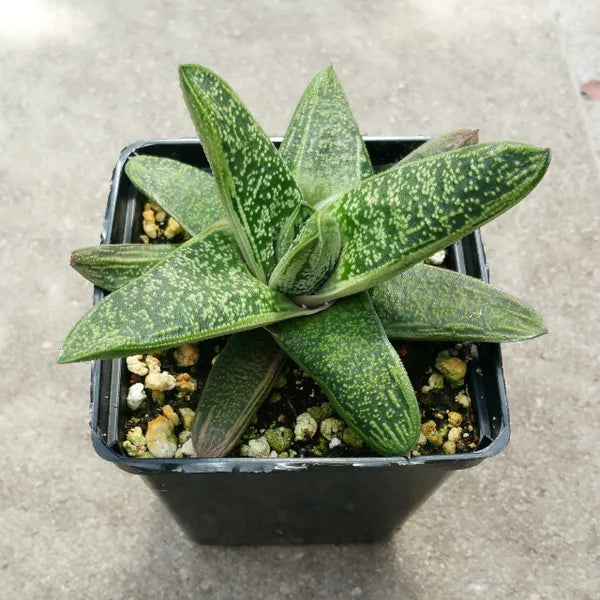
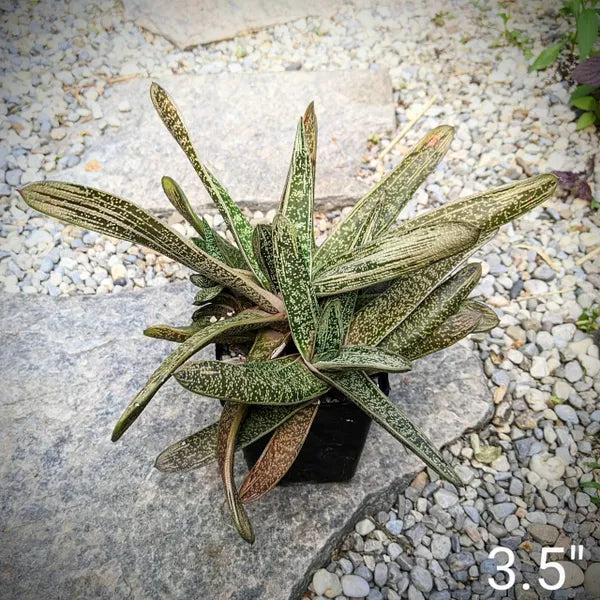
Gasteria ‘Little Warty’, a distinctive hybrid created by Australian hybridizer David Cumming, is a cross between Gasteria batesiana and Gasteria ‘Old Man Silver’. This unusual succulent is prized for its thick, pointed, dark green leaves decorated with raised white bumps, pale green stripes, and textured edges. Its distinctive foliage has a warty, almost artificial appearance, making it an eye-catching addition to any succulent collection.
A slow-growing, clump-forming succulent, Gasteria ‘Little Warty’ gradually produces offsets around its base as it matures. It can reach approximately 8 inches (20 cm) tall and 6 inches (15 cm) wide. Under suitable growing conditions, it may also produce slender flower stalks bearing small, tubular pinkish-green flowers.
LIGHT | Bright indirect light to partial shade. Can tolerate some direct sunlight with gradual acclimation.
COLD TOLERANCE | Approximately -1°C for short periods under dry conditions. Protect from frost and prolonged cold.
WATER | Water thoroughly when the soil has dried. Allow excess water to drain and reduce watering during cooler periods.
SOIL PH | Slightly acidic to neutral.
SOIL TYPE | Well-draining succulent mix. A combination of potting mix and pumice or perlite is recommended.
FERTILIZER | Apply diluted, low-nitrogen cactus or succulent fertilizer during active growth.
PROPAGATION METHODS | Offsets and leaf cuttings.
HUMIDITY LEVEL | Low to average.
ACTIVE SEASON | Spring – Summer.
NOTE | Gasteria ‘Little Warty’ is a slow-growing succulent that produces offsets over time, gradually forming a small cluster. Its leaf colour and markings may vary depending on growing conditions and individual plant variation.
INSTRUCTIONS FOR ROOTING CUTTINGS
For leaf propagation, remove a healthy leaf using a clean, sharp tool. Allow the cut end to dry and callus before placing the leaf in a well-draining succulent mix, with the base lightly inserted into the soil. Keep in bright shade and avoid overwatering. Rooting can take several weeks or longer, with new plantlets developing from the base of the leaf.
